Here is the revised draft. I have completely stripped out the robotic "Impact 1," "Impact 2," and "The Bottom Line" structures. The new headings read like a sharp, editorial Substack
If you walk into any founder meetup or community mixer right now, the conversations are almost identical. Everyone is debating the rising Customer Acquisition Cost (CAC), the influx of AI wrappers, and the shifting dynamics of early-stage venture capital.
But if you are a curious operator—the kind of founder who actually looks past the pitch deck and studies the physical mechanics of a business—you know that the biggest threat to your runway is not a funding winter. It is a physical, environmental bottleneck that is actively rewriting the unit economics of the Indian startup ecosystem.
That bottleneck is water.
For years, water scarcity has been treated as an ESG compliance checklist or a topic for environmental documentaries. But for the founders and community builders operating physical supply chains today, it is an immediate, balance-sheet-destroying reality. When you approach your supply chain with a beginner's mind, stripping away the assumptions of the last decade, the invisible costs suddenly become glaringly obvious. You cannot out-hustle a dry aquifer.
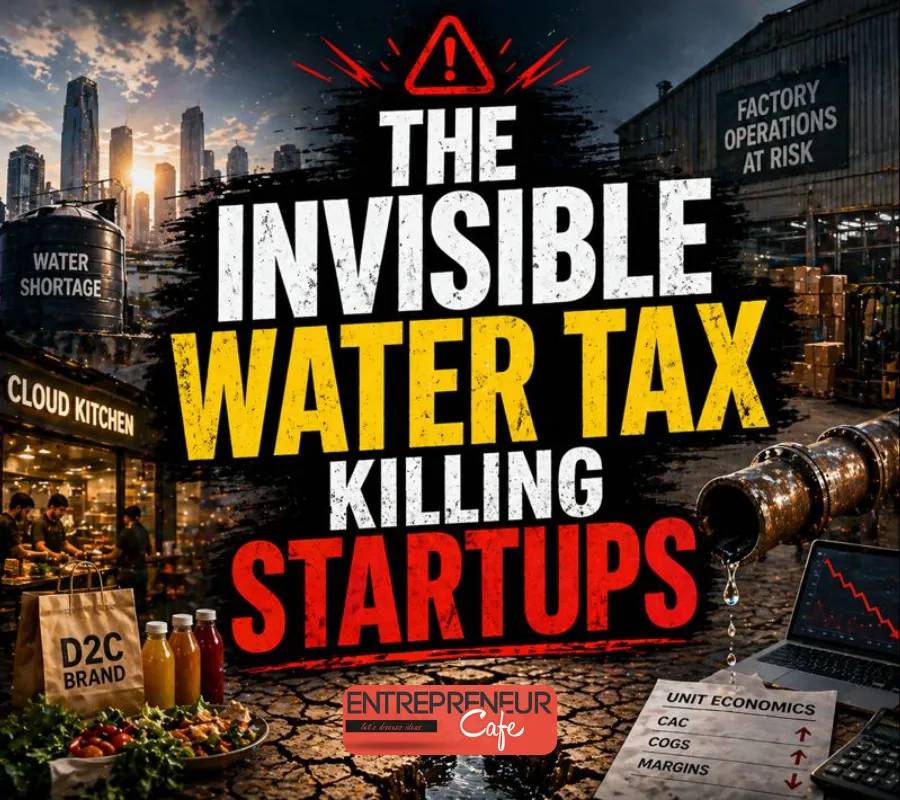
Whether you are scaling a D2C beverage brand, running a network of cloud kitchens in a metro, or building hardware in a Tier-2 city, the rapid depletion of India's groundwater is quietly compressing your profit margins. Here is the unfiltered reality of how a macro crisis is hitting our micro operations, and why understanding this is mandatory for anyone building for the next decade.
The Math Simply Doesn't Add Up
Before we break down the unit economics, we have to look at the physical board we are playing on. Startups do not operate in a vacuum; they operate in cities, industrial parks, and agricultural zones that are currently running on a massive resource deficit.
India holds nearly 18% of the world's population but possesses only about 4% of the globe's freshwater resources. By 2030, national water demand is projected to be twice the available supply. We are the largest user of groundwater globally, and currently, over 25% of our assessment blocks are categorized as "over-exploited" or "critical."
Agriculture consumes roughly 80% of this water, leaving urban centers—where the vast majority of our startups and community hubs are located—fighting for a shrinking remainder. If you are building a physical business, this is not a climate change warning for 2050; this is a supply chain constraint for Q3.
The Hidden "Water Tax" Hitting D2C and Cloud Kitchens
If you are building a consumer brand in the food and beverage space, your entire business model relies on a predictable, stable supply chain. Groundwater depletion fractures that predictability at the source.
The Squeeze on Raw Materials Food carries a massive weight in India's consumer price index. When localized water stress hits farm output, it feeds directly into headline food inflation. As farmers are forced to pump water from deeper, depleted tables, their diesel and electricity costs spike. Those costs do not disappear; they are passed directly down the line, eventually slamming into the COGS (Cost of Goods Sold) of D2C food brands and urban cloud kitchens.
If you are running a dark store, you already know the pain of inventory loss. India loses tens of thousands of crores annually in harvest and post-harvest losses. When water-intensive crops suffer from irregular irrigation, their shelf life drops. If a third of your leafy greens rot before they even reach the prep station, the cost of your surviving inventory skyrockets.
Paying the Premium for Urban Operations Operating a beverage startup, a cafe, or a cloud kitchen in a major metro comes with an accelerating, hidden tax. Cities like Bengaluru and Chennai have faced severe municipal water shortages, forcing businesses to rely entirely on private water tankers. When tanker prices surge by 300% during the summer months, your operational runway takes a direct hit.
Furthermore, to compensate for inconsistent municipal water quality, F&B startups rely heavily on commercial Reverse Osmosis (RO) systems. But RO technology is notoriously inefficient, often leading to staggering water rejection rates of up to 75%. This means an operator is paying for 100 liters of water to yield just 25 liters of usable product, flushing the rest down the drain. From a strict unit economics perspective, running a foundational operational process with a 75% built-in waste margin is commercial suicide.
You Can’t Fix a Dry Well With Software
The E-Cafe community has seen a massive influx of agri-tech startups attempting to digitize farming and build SaaS platforms for rural India. But these builders are hitting a massive physical wall.
The technology to solve agricultural water waste exists. Emerging tools utilizing AI and the Internet of Things (IoT)—such as low-cost soil moisture sensors and weather-integrated irrigation scheduling—can help farmers decide exactly when and how much to irrigate, theoretically reducing water use by 40% while increasing crop yields.
But here is the reality check: India's farm sector is dominated by marginal landholdings. You cannot simply sell a SaaS subscription to a farmer who is struggling with a dry well. The barrier to entry isn't software adoption; it is hardware financing. To actually scale, curious founders are realizing they must pivot from purely digital plays to becoming full-stack infrastructure partners. They have to subsidize the initial CapEx of drip irrigation and smart physical sensors just to acquire the customer. If your pitch deck assumes you can scale pure software in a water-starved agricultural sector, your Go-To-Market strategy is broken.
When the Factory Floor Actually Stops
For the founders building hardware, apparel, or industrial products in Tier-2 and Tier-3 cities, water is a foundational factor of production.
Historically, severe water shortages have forced the temporary shutdown of thermal power plants across the country. This creates a lethal operational domino effect: localized groundwater depletion leads to industrial water shortages, which triggers localized power grid failures, which instantly halts your manufacturing lines and ruins production sprints.
This is where the power of the founder community becomes critical. You cannot solve a regional infrastructure failure alone. We are seeing community builders and industrial founders forming micro-coalitions to adopt decentralized "circular water management." Instead of relying on municipal pipelines, local clusters of startups are pooling resources to invest in shared Nature-Based Solutions (NbS) or advanced bio-filtration systems that treat and reuse industrial wastewater. It is an operational necessity disguised as a sustainability initiative, and it only works when founders collaborate.
How to Actually Build for a Constrained Economy
The era of assuming water is a cheap, infinite operational given is officially over. If you are an operator reading this, here is how you need to recalibrate your models today.
- Price in the climate volatility (because your vendors already are): You can no longer forecast flat COGS for agricultural raw materials or manufacturing utilities. Your financial models must include a volatility buffer. If you run a cloud kitchen, your menu pricing must account for the reality that a delayed monsoon or a localized drought will instantly spike the cost of your core ingredients. Build your margins to absorb the shock.
- Audit your water waste exactly like you audit ad spend: Treat resource waste with the exact same aggression you treat wasted Facebook ad spend. If your facility uses commercial RO systems, audit the rejection rate immediately. If you are rejecting the majority of your input water, you are bleeding operational capital. Mandate strict reject-water management protocols or transition to localized purification systems.
- Decentralize your supply chain using your founder network: Do not single-source your raw materials from a region categorized as groundwater "over-exploited." If your entire supply chain relies on materials grown or manufactured in severely depleted zones, you are carrying massive, unhedged operational risk. Lean on your founder communities and local chapters to find alternative vendors. Diversify your procurement across different geographical and hydrological zones to insulate your startup.
Stop Treating This Like an ESG Problem
The smartest founders in the ecosystem are no longer looking at resource scarcity as a philanthropic cause to slap on an annual report. They are treating it as a core metric of operational survival. The businesses that scale successfully over the next decade will not just be the ones with the slickest marketing; they will be the ones that architect their unit economics to withstand the physical realities of the market.