Every great startup begins with a founder’s intuition.
In the early days of building a company, there is no historical data to parse, no standard operating procedures (SOPs) to fall back on, and no established market benchmarks for your specific micro-niche. You rely entirely on your gut to find your first ten paying customers, to convince your core team to join a risky venture, and to pivot the product when the initial thesis inevitably fails. That raw intuition is your ultimate superpower. It is the engine that gets a business from zero to one.
But here is the harsh, systemic reality that catches almost every early-stage Indian founder off guard: the exact same intuition that successfully built your company will eventually become the primary bottleneck that chokes its growth. What gets a startup to its first ₹1 Crore in revenue is rarely what gets it to ₹10 Crore, and it will absolutely never get it to ₹100 Crore.
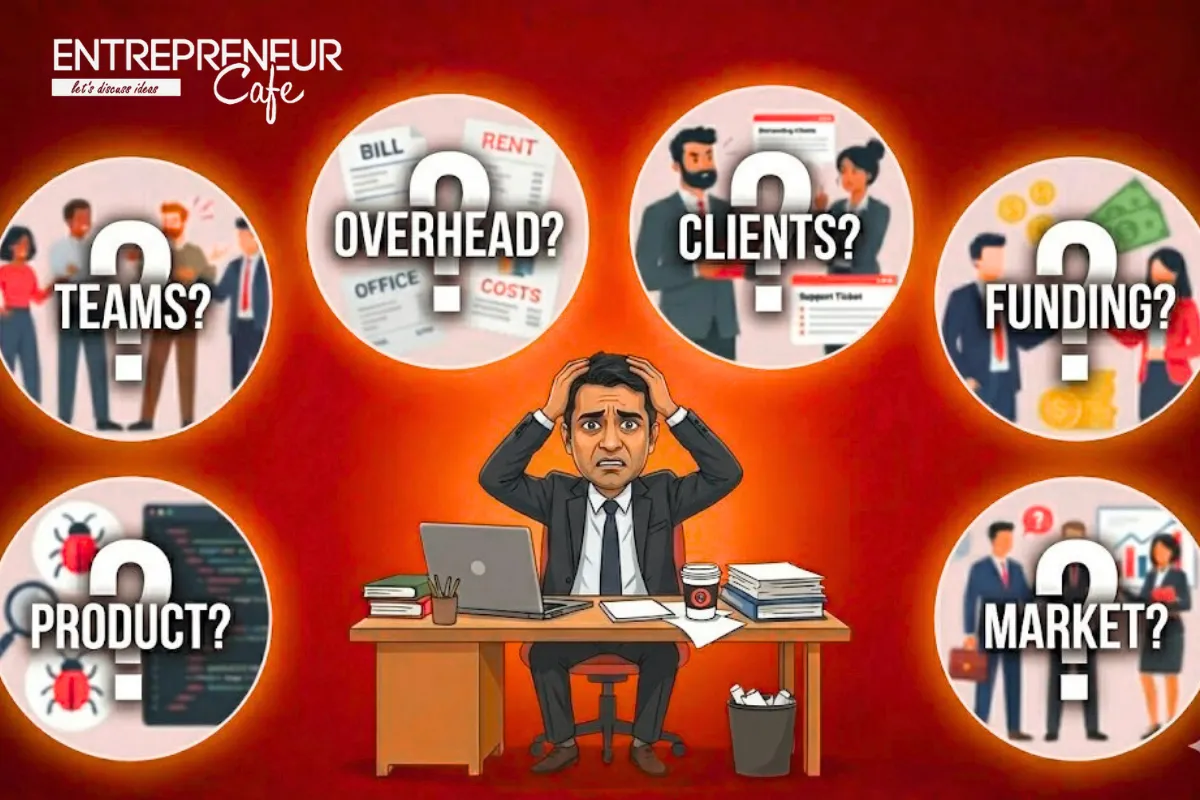
At Entrepreneur Cafe, we see this transition play out constantly across our local chapters. Founders hit an invisible ceiling. They are working 80-hour weeks, their teams are expanding, but revenue plateaus, margins shrink, and operational chaos multiplies.
This is the moment a founder must realize their "gut feeling" has run its course. Here is the operational playbook for transitioning out of intuition-led hustle and into a logic-driven, systematic operation.
The Intuition Trap and The Hub-and-Spoke Model
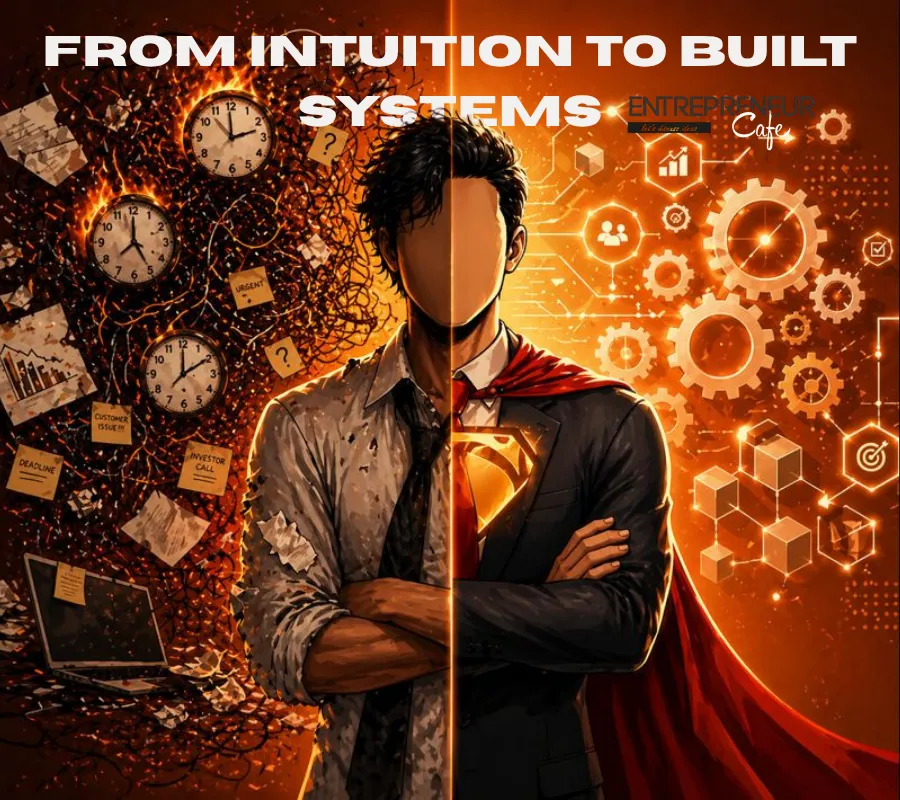
When a startup is run purely on founder intuition, the organizational structure usually defaults to a "hub-and-spoke" model. The founder sits dead in the center (the hub), and every single department, employee, and micro-decision radiates outward from them (the spokes).
Marketing needs you to approve the Instagram copy. Sales needs you to sign off on a B2B discount. Product needs your blessing on the new user interface. Customer success needs you to handle a high-ticket escalation.
For a passionate founder, this feels like quality control. It feels like you are "in the weeds" and ensuring the brand standard is met. But it is actually a lethal operational trap.
When you scale, the sheer volume of daily micro-decisions multiplies exponentially. If your team has to wait for your "gut check" on every operational task, your company's growth is strictly capped by your physical and mental bandwidth. You stop being a visionary leader and become a massive operational roadblock. The speed of execution slows down to the speed of your personal inbox.
The "Hero Culture" Epidemic
A direct byproduct of the intuition trap is the development of "Hero Culture." This is deeply ingrained in the startup ecosystem, where aggressive hustle is glorified above all else.
Hero culture exists when a business survives solely because of the superhuman, brute-force efforts of the founder or a few core early employees. It looks like this: A massive logistics failure happens on a Friday evening, and instead of triggering a pre-planned system to fix it, the founder stays up until 3:00 AM manually calling delivery partners and apologizing to customers.
The team applauds the founder's dedication. Investors might even praise the grit. But from an operational standpoint, this is a massive failure. If a process requires a hero to save the day, the process is fundamentally broken.
Hero culture does not scale. You cannot hire 50 heroes. You cannot build a predictable, investable business model if your unit economics rely on people working 14-hour days to cover up systemic inefficiencies. Ego often disguises itself as quality control, but true quality control operates silently in the background, without requiring anyone to wear a cape.
Identifying the Breaking Point: Three Killer Flags
How do you know it is time to pivot from intuition to logic? You cannot simply wake up and declare your company "systemized." You must look for the operational breaking points. Watch for these three killer flags in your daily operations:
1. The Repeated Mistake: Your team keeps making the exact same errors, or you find yourself answering the same basic questions week after week. If an employee asks you how to handle a specific refund scenario twice, it is no longer their fault; it is your fault for not having a documented policy.
2. The Invisible Onboarding: When you hire a new employee, it takes them three to six months to become genuinely productive. Why? Because all the institutional knowledge is locked inside the founder's head. The new hire has to learn by osmosis, making mistakes and waiting for you to correct them based on your "gut," rather than reading a manual and executing flawlessly from week one.
3. The Vacation Test Failure: This is the ultimate litmus test. Can you turn your phone off, completely disconnect from the internet, and walk away from your business for 14 straight days? If the answer is no—if the business would lose major clients, miss payroll, or grind to a halt—you do not own a business. You own a very high-stress, high-liability job.
The Playbook: Transitioning to "Tier-One" Systems
Moving from a hustle-driven culture to a systems-driven culture is fundamentally unsexy. It requires trading the daily adrenaline of putting out fires for the quiet predictability of a well-oiled machine.
Here is the step-by-step framework for making that critical shift:
Step 1: Document the "Boring" Stuff (The SOP Audit)
A system is simply a successful intuition that has been codified and written down. Start with your most repetitive, high-frequency tasks.
How do you qualify a B2B lead? What is the exact sequence of events the moment a customer files a critical complaint? How is your monthly inventory reconciled?
Write down the exact, step-by-step logic. Create Standard Operating Procedures (SOPs). Use video recording tools to screen-record yourself doing a digital task and have an assistant transcribe it into a checklist. If you get hit by a bus tomorrow, a reasonably competent stranger should be able to read that document and keep the lights on without needing to call you.
Step 2: Shift Your Hiring Metric from "Hustle" to "Logic"
In the zero-to-one phase, you hire for pure hustle. You need generalists who can wear six different hats, embrace the chaos, and sprint.
But in the one-to-ten phase, the profile of your ideal hire must change drastically. You need to start hiring for "logic." You need specialists who actively despise chaos. You want operators who get annoyed when they have to put out a fire, and whose immediate instinct is to build a fireproof wall so it never happens again. Do not hire more generalists to fix systemic issues; hire system builders.
Step 3: Practice Outcome-Based Delegation (The 80% Rule)
The hardest psychological hurdle for a founder is letting go of the execution. Building systems does not mean you resort to micromanagement; it means you set clear parameters.
To successfully remove yourself as the bottleneck, you must set strict Key Performance Indicators (KPIs) and operational boundaries for your team, but you must let them figure out the execution.
Enter the 80% Rule: You must be willing to let a team member complete a task 80% as well as you would have done it yourself. That 20% drop in absolute perfection is the cost of scalability. By accepting an 80% outcome, you free up 100% of your time to focus on high-leverage activities—like raising capital, forging strategic partnerships, recruiting top-tier talent, and opening new markets.
The Reality Check: Making Yourself Obsolete
The ultimate goal of an effective founder is to systematically make themselves operationally obsolete.
It sounds counterintuitive, especially for entrepreneurs whose personal identities are deeply tied to the daily operations of their companies. But an investable, scalable business is an autonomous machine. It generates revenue, serves customers, and solves routine problems without needing the founder's permission to breathe.
If your startup cannot survive a week without your direct, granular input, it is time to stop trusting your gut and start building your systems. The future of your company depends entirely on your ability to get out of its way.