For the last decade, the Indian startup ecosystem operated on a singular, unquestioned geographic mandate: if you want to build a generation-defining company, you must move to Bengaluru, Delhi NCR, or Mumbai.
The logic was sound during the zero-interest-rate era. You moved to a Tier-1 metro to be close to the venture capital, the elite engineering talent, and the serendipitous networking of HSR Layout or Powai. But as the ecosystem transitions from software wrappers to deep-tech, hardware, and complex supply chains, the fundamental math of the Tier-1 metro is breaking down.
When you strip away the PR hype of the "tech capital" and look purely at a startup’s balance sheet, operating heavily in a major metro is no longer a strategic advantage; it is a massive, unhedged operational liability.
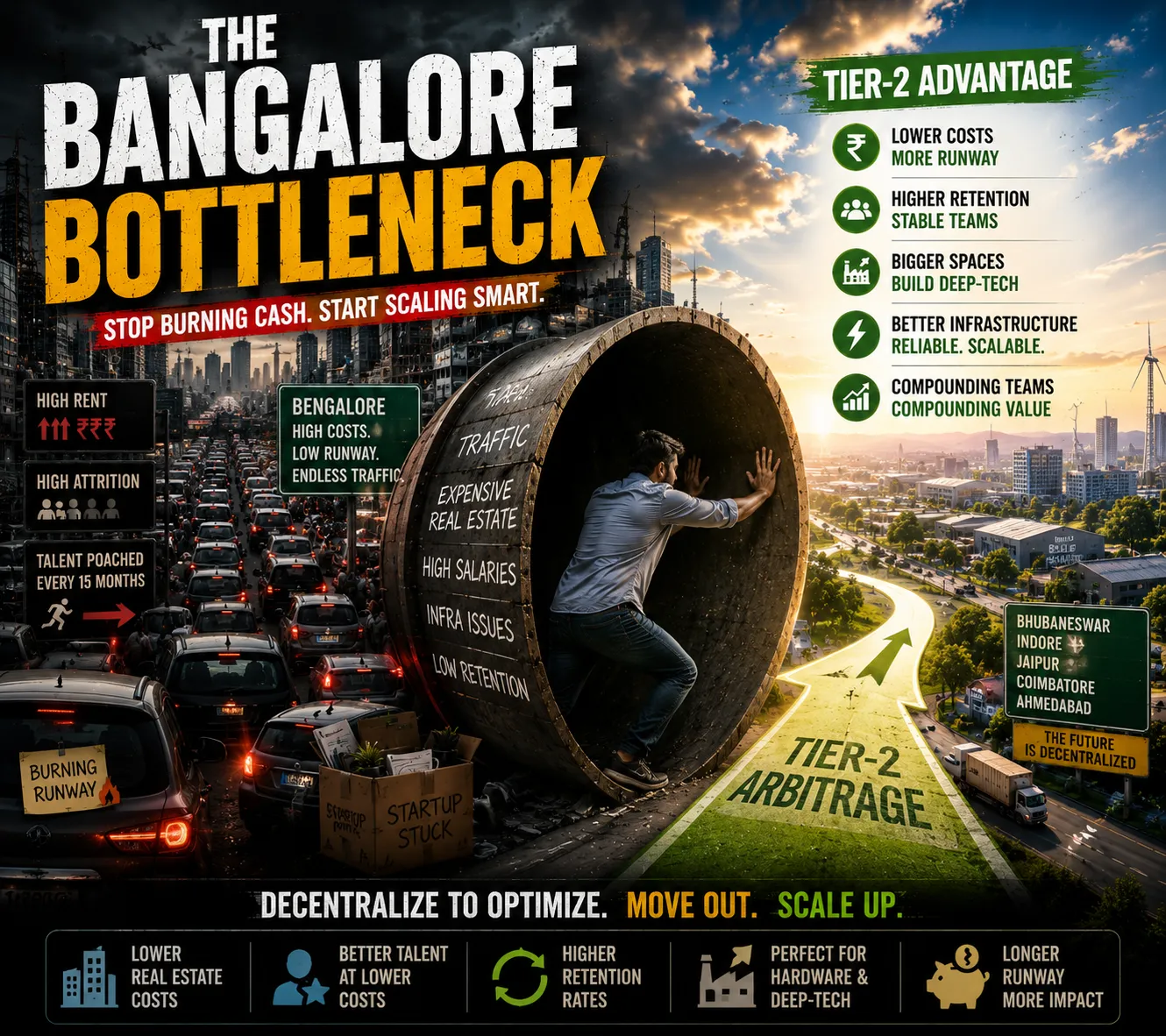
Welcome to the Bangalore Bottleneck. Here is the unfiltered reality of how Tier-1 cities are crushing unit economics, and why the "Tier-2 Arbitrage" is the most powerful operational lever a founder can pull in 2026.
The Mathematics of the Metro Premium
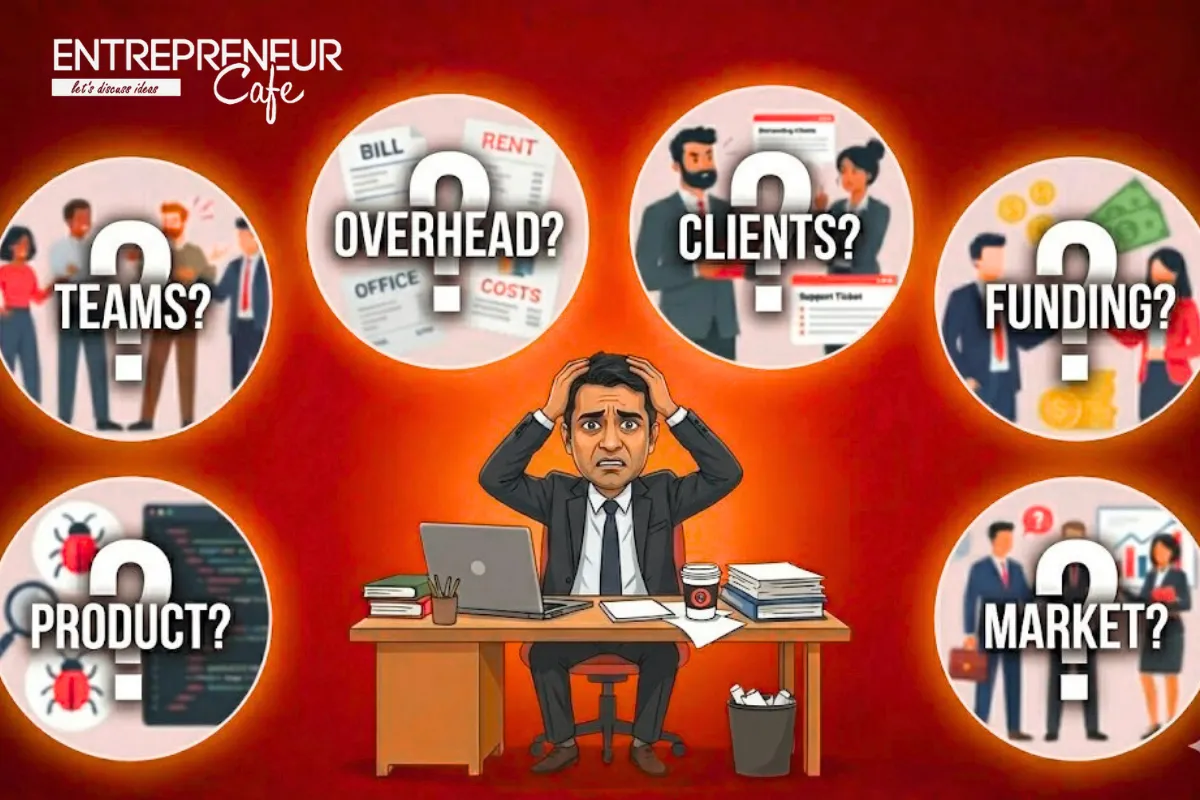
When founders secure a Seed or Series A round, they typically run their financial models assuming that capital will be deployed toward product development, customer acquisition, and engineering talent.
The reality is that a terrifying percentage of that venture capital is immediately absorbed by the "Metro Premium"—the inflated cost of commercial real estate and the cascading cost of living adjustments required to keep employees afloat in a choked city.
Commercial real estate in prime tech corridors has reached a point of diminishing returns. When a startup pays premium per-square-foot rates just to house a customer support team or a mid-level operations desk, they are actively bleeding runway. If you are building a pure SaaS company with ten employees, maybe you can justify the rent. But if you are building physical infrastructure—like the 10-minute delivery dark stores in Quick Commerce, the smart warehouses in AgriTech, or hardware assembly lines—Tier-1 real estate costs instantly destroy your gross margins.
The Talent Retention Crisis
The second layer of the Bangalore Bottleneck is the illusion of the "talent pool."
It is true that major metros hold the highest concentration of elite engineers and product managers in the country. However, that density has created a hyper-competitive, toxic hiring environment where retention is practically impossible.
In micro-hubs like Koramangala or Indiranagar, the average tenure of a mid-level software engineer is frequently less than 15 months. You are not building a team; you are running a training academy for your competitors. The moment you onboard an engineer, they are already being poached by a better-funded competitor offering a 30% salary hike.
This hyper-attrition carries a massive, hidden operational cost. The downtime of an empty role, the recruitment fees, and the months required to get a new hire up to speed on your codebase create severe friction in your product roadmap.
Contrast this with the Tier-2 Arbitrage. Founders setting up operational and engineering hubs in cities like Bhubaneswar, Indore, or Jaipur are finding a completely different talent dynamic. By tapping into the massive pool of engineers who prefer to stay close to their hometowns and avoid the brutal cost-of-living and traffic of the metros, startups are securing elite talent at a fraction of the cost. More importantly, the retention rates in these Tier-2 hubs are exponentially higher. You get to actually compound your team's knowledge instead of replacing them every year.
The Deep-Tech and Hardware Migration
We are seeing a massive sector rotation away from consumer apps and into deep-tech, space-tech, and bio-manufacturing. This shift fundamentally changes the physical requirements of a startup.
You cannot build a 500kg/day insect bio-factory, a drone manufacturing line, or a proprietary aeroponic farm in a cramped co-working space. Hardware and deep-tech require massive floor space, heavy electricity loads, and highly reliable water supplies.
As we covered in our recent sectoral update on India's groundwater crisis, Tier-1 cities are facing severe municipal infrastructure failures. Rolling blackouts and dry municipal grids force startups to rely on expensive diesel generators and private water tankers, inflating the Cost of Goods Sold (COGS).
The Tier-2 Arbitrage solves this at the root. State governments in Odisha, Madhya Pradesh, and Rajasthan are aggressively rolling out specialized industrial parks, subsidized electricity rates, and single-window clearances to attract deep-tech founders. The CapEx (Capital Expenditure) required to set up a hardware assembly line in Bhubaneswar is a fraction of what it costs on the outskirts of Bengaluru, allowing founders to run longer Design-Build-Test cycles without bankrupting themselves.
The E-Cafe Playbook: The Decentralized Hub-and-Spoke Model
The smartest operators in the E-Cafe network are no longer arguing about "remote versus in-office." They are adopting a strict, geographically decentralized Hub-and-Spoke model optimized purely for unit economics.
1. The Strategic Hub (Tier-1): You still need a presence in the capital centers. Keep a hyper-lean executive and strategic team in Bengaluru or Delhi. This is where your CEO, Head of Fundraising, and strategic partnership leads sit. It is a small footprint optimized for venture capital meetings, networking, and enterprise sales.
2. The Execution Spoke (Tier-2/3): Move your core execution out of the metro. Your engineering floor, your customer success teams, your supply chain logistics, and your manufacturing should be headquartered in a Tier-2 city. By shifting the bulk of your headcount and physical footprint to cities with lower real estate costs and higher employee retention, you can effectively double your operational runway on the exact same round of funding.
3. Digitize the Culture, Not Just the Work: To make a distributed model work, your internal documentation must be flawless. You cannot rely on "water cooler chats" to make product decisions. Every pivot, every supply chain shift, and every engineering roadmap must be rigorously documented so that the execution team in the Tier-2 hub is perfectly aligned with the strategic team in the Tier-1 metro.
The Bottom Line
Geography is no longer just a mailing address; it is a core component of your unit economics.
If you are paying metro premiums for operations that could be executed flawlessly in a Tier-2 city, you are not being a strategic founder—you are just subsidizing a commercial landlord. The founders who survive the next decade of consolidation will be the ones who leverage the physical arbitrage of "Bharat" to out-last and out-build their metro-bound competitors.