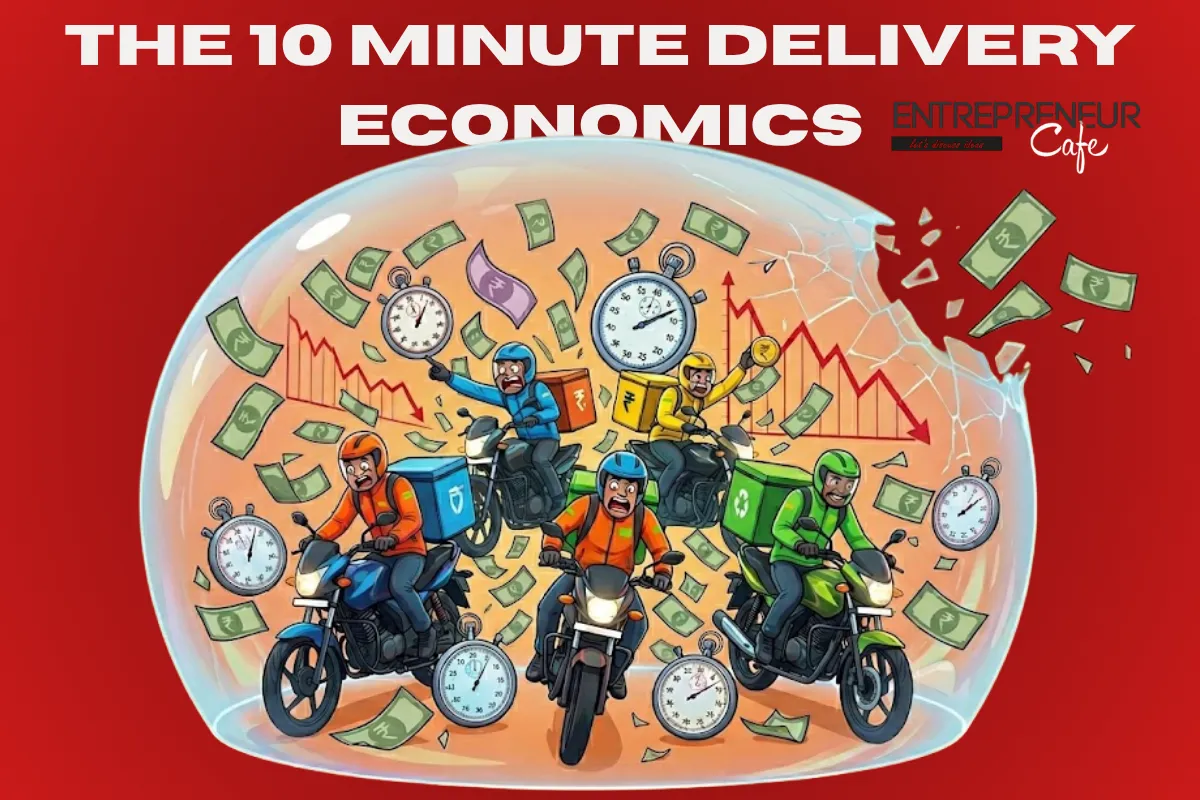
Look around any major Indian metro right now, and the roads are dominated by neon-clad delivery riders promising groceries in ten minutes. As consumers, we love it. As a startup ecosystem, we applaud it.
But if you look past the sleek app interfaces and the aggressive marketing campaigns, a massive structural question remains: Are these platforms actually building a sustainable competitive moat, or are they simply burning venture capital to subsidize our impatience?
For founders building in 2026, the quick commerce battleground is the ultimate masterclass in unit economics, operational friction, and the dangers of buying customer loyalty. Here is the reality behind the 10-minute promise.
The Physics of the 10-Minute Delivery
To deliver an order in ten minutes, a company cannot rely on a centralized warehouse. They must build a hyper-local network of "dark stores" nested deep within residential neighborhoods.
This creates an immediate, heavy operational drag:
- Real Estate Costs: Commercial real estate in prime metro pin codes is notoriously expensive. Dark stores require constant electricity (for refrigeration) and premium rent.
- Inventory Fragmentation: Instead of holding 10,000 units of a product in one central hub, the platform must distribute those units across 50 smaller hubs. This leads to higher wastage, stockouts, and complex logistics.
- The Rider Equation: The model relies on a dense fleet of gig workers. But as fuel prices fluctuate and platform incentives inevitably drop, rider churn skyrockets. When unit economics squeeze the rider, the delivery times collapse.
The physics of this model means that the base cost of fulfilling an order is incredibly rigid. You cannot negotiate with the distance, the traffic, or the price of fuel.
The Myth of "Sticky" Customers
The defense for burning cash to acquire quick commerce customers is usually "Customer Lifetime Value" (CLTV). The logic is simple: get them addicted to 10-minute deliveries, and they will never leave.
But the data tells a different story.
When you train a customer to value convenience above all else, their loyalty belongs to the convenience, not your brand. If Platform A promises 10 minutes and Platform B promises 9 minutes (or offers a ₹50 discount), the customer switches instantly.
You haven't built a moat; you have built a mercenary user base. They aren't paying the true cost of the delivery—the venture capitalists are. And the moment those VC subsidies dry up and delivery fees rise to reflect their actual cost, the "sticky" consumer behavior vanishes.
What This Means for Early-Stage Founders
The quick commerce wars are a highly visible reminder of a trap that catches thousands of startups: confusing customer acquisition with product-market fit.
If your business model requires you to subsidize the true cost of your product just to keep people using it, you are playing a dangerous game. True product-market fit happens when a customer is willing to pay a price that covers your operational costs and leaves a margin for growth.
Before you scale, pressure-test your unit economics without the safety net of discounts:
- Identify your true fulfillment costs: What does it cost to deliver your product or service when everything goes wrong?
- Stress-test your retention: Will your customers still buy from you if you raise your prices by 15% tomorrow? If the answer is no, your product isn't a painkiller; it's a vitamin.
- Build physical moats: Look at legacy FMCG brands. They survive because they master supply chains, build deep distribution networks, and create products with intrinsic value.
The Bottom Line
Growth at all costs is a relic of the past. The startups that will dominate the next decade of the Indian ecosystem won't be the ones that deliver the fastest. They will be the ones whose math actually works.
Let me know if you want to tweak any of the messaging here, or if we should move straight into drafting the Thursday Founder's Playbook piece!